

Introduction
Build voice AI agents that can make and receive real-time phone calls with human-like latency, conversational intelligence, and enterprise reliability.
What is Tunk.ai?
Tunk.ai is an enterprise Voice AI platform for engineering, deploying, and monitoring conversational voice agents. We manage the real-time audio pipeline, telephony infrastructure across global telecom carriers, sub-second latency optimization, and multi-provider AI model orchestration so your team can focus on conversational workflows.
With Tunk.ai Voice AI, you can:
- Deploy conversational voice agents with sub-second response times and natural interruption handling.
- Make and receive phone calls natively via imported Twilio, Plivo, and Vonage phone numbers.
- Connect custom APIs & tools via REST webhooks and Model Context Protocol (MCP) servers.
- Ground agent responses with factual knowledge using document repositories (PDF, DOCX, TXT) and semantic RAG.
- Run automated outbound campaigns to dial thousands of contacts with dynamic variables.
- Bring Your Own Credentials (BYOC) across 9 AI providers for 0% token markup and direct account billing.
 Tunk.ai Platform Overview
How the Voice AI Pipeline Works
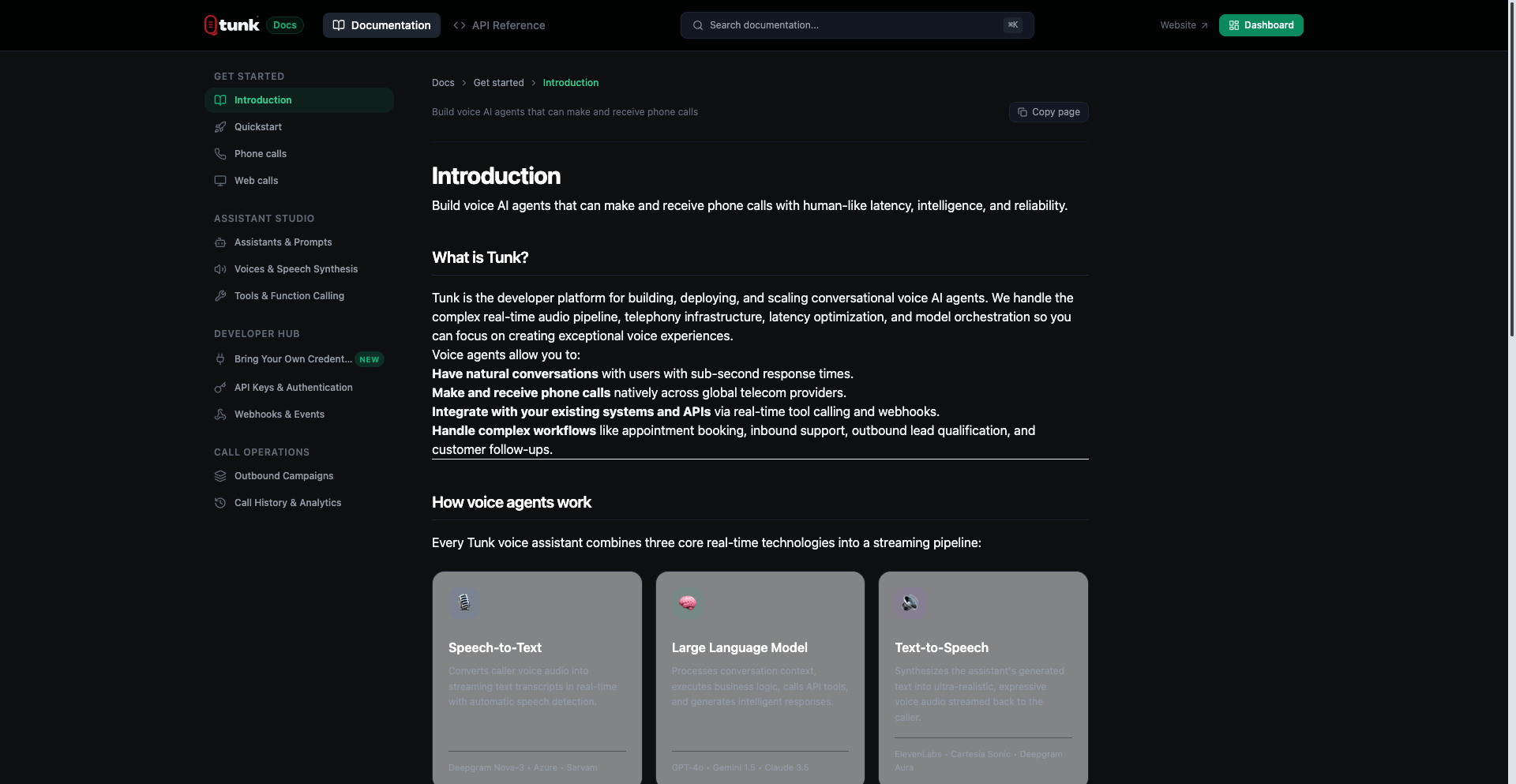
Every live phone call on Tunk.ai runs through a tightly synchronized, streaming audio pipeline:
Caller Audio ──▶ [1. STT Transcriber] ──▶ [2. LLM Engine] ──▶ [3. TTS Synthesizer] ──▶ Spoken Audio
(Telephony) Deepgram / Azure GPT-4o / Gemini ElevenLabs / Cartesia (Telephony)1. Speech-to-Text
Converts caller voice audio into real-time streaming transcripts with endpointing and speech silence detection.
2. Large Language Model
Processes conversation turns, queries RAG knowledge bases, triggers external tools, and generates responses.
3. Text-to-Speech
Synthesizes LLM tokens into lifelike, expressive voice streams sent directly back down the audio channel.
Platform Navigation Map
Quickly jump to the relevant section of the dashboard:
| Feature Area | Description | Direct Dashboard Link |
|---|---|---|
| Anchor AI | Conversational builder to generate, inspect, and test assistants | Open Anchor AI → |
| Assistant Studio | Configure models, prompts, voices, call settings, and post-call analytics | Open Assistant Studio → |
| Phone Numbers | Import and manage Twilio, Plivo, and Vonage phone numbers | Open Phone Numbers → |
| Knowledge Base | Ingest PDFs, DOCX, and text files for grounded RAG | Open Knowledge Base → |
| Tools & MCP | Build custom REST API tools and connect MCP servers | Open Tools → |
| Outbound Campaigns | Upload CSV contact lists and launch batch call campaigns | Open Campaigns → |
| Call Records | Listen to audio recordings, inspect transcripts, and view analytics | Open Call Records → |
| BYOC Integrations | Connect your OpenAI, Deepgram, Azure, and ElevenLabs API keys | Open BYOC Integrations → |
| API Keys | Generate secret workspace tokens for programmatic requests | Open API Keys → |
| Do Not Disturb (DND) | Set calling hours and regulatory quiet-period restrictions | Open DND Rules → |
Credential Options: Platform vs. BYOC
Tunk.ai provides two flexible models for powering your AI voice infrastructure:
- Platform Managed (Default): Use Tunk.ai's pre-configured cloud accounts for LLMs, STT, and TTS. Billed directly from your Tunk workspace credit balance per call second.
- Bring Your Own Credentials (BYOC): Connect your own API keys for OpenAI, Google Gemini, Deepgram, Azure, ElevenLabs, Cartesia, Sarvam AI, Smallest.ai, or AssemblyAI. Pay your provider directly with zero token markup.